
AI Impact on Tech Jobs in Canada: What the 2026 Data Shows
Last reviewed: October 19, 2026
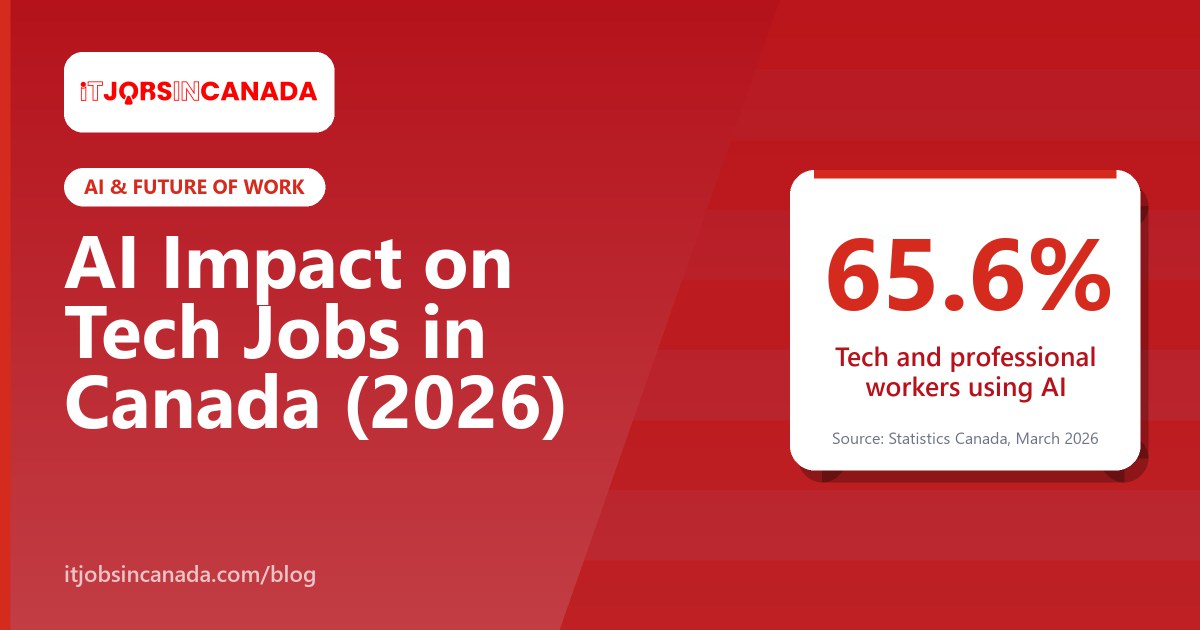
Short answer: the AI impact on tech jobs in Canada is mostly about changing how work is done rather than mass job losses, so far. Statistics Canada found that 35.9% of Canadian workers used generative AI tools at work in the year to March 2026, rising to 65.6% in professional, scientific and technical services, where most tech workers are. The wider job market is softer: unemployment rose to 6.5% in September 2026, and youth unemployment was 13% (Labour Force Survey). That makes it harder for new grads to break in.
Key takeaways
How many Canadian tech workers use AI?
Statistics Canada's first TechStat release, published July 30, 2026, measured generative AI use at work for the first time in this detail. In professional, scientific and technical services, which include software, IT consulting and engineering, two in three workers used tools like ChatGPT, Copilot or Gemini. Most use AI for some tasks rather than most: 63.5% of users said they used it moderately, and just over three in 10 used it daily.
Is AI taking tech jobs in Canada?
Not on a large scale yet. Canada's tech job market has been weaker since 2023 because of high interest rates, cautious venture funding and big-tech layoffs. AI is one factor among several. What AI is clearly doing is raising the bar: teams can deliver more with fewer junior people, and employers expect developers to use AI tools well.
Which tech roles are most exposed?
| Exposure | Roles |
|---|---|
| Higher | Entry-level coding, manual QA testing, level-1 tech support, technical writing, data entry and basic reporting |
| Changing | Software developers, data analysts, business analysts, product managers |
| Growing | AI/ML engineers, data engineers, cloud and DevOps, cybersecurity, AI governance and responsible AI |
Where is Canada strong in AI?
Canada is home to world-class AI research institutes, Mila in Montréal, the Vector Institute in Toronto and Amii in Edmonton, and a large AI startup ecosystem. That creates demand for ML engineers, research engineers and applied AI developers, especially in Toronto, Montréal, Edmonton and Vancouver.
How can you stay in demand?
What to do next
Create a free ITjobsinCanada account and browse AI developer jobs, software development jobs or all the latest IT jobs in Canada.
Sources
ðŸ·ï¸ Tags
Frequently asked questions
How many Canadian workers use AI at work?
Statistics Canada found that 35.9% of Canadian workers used generative AI tools at work in the 12 months to March 2026.
Do tech workers in Canada use AI more than others?
Yes. In professional, scientific and technical services, 65.6% of workers used generative AI, compared with 35.9% across all workers.
Is AI taking tech jobs in Canada?
Not on a large scale yet. AI is raising expectations and reducing some junior work, but the tech job market has also been affected by interest rates, funding and big-tech layoffs.
Which tech jobs are most at risk from AI in Canada?
Entry-level coding, manual QA testing, level-1 tech support, technical writing and routine data work are the most exposed.
What is the unemployment rate in Canada?
Canada's unemployment rate rose to 6.5% in September 2026, and youth unemployment was 13%, according to the Labour Force Survey.
Where are AI jobs in Canada?
Toronto, Montréal, Edmonton and Vancouver are the main AI hubs, supported by the Vector Institute, Mila and Amii and a large AI startup ecosystem.
Author
The AI impact on tech jobs in Canada in 2026: 35.9% of workers now use generative AI, rising to 65.6% in professional and technical services. What it means.About This Blog
The AI impact on tech jobs in Canada in 2026: 35.9% of workers now use generative AI, rising to 65.6% in professional and technical services. What it means.